
Understanding the age of a tree is more than just a curiosity — it’s essential for forestry management, landscaping, environmental studies, habitat evaluation, and even historical preservation. Trees silently record decades, centuries, and in rare cases, millennia of environmental change. But unlike humans, trees don’t carry a birth certificate, so how do we determine their age?
This guide explains every reliable method used by arborists, foresters, researchers, and homeowners. From simple circumference-based calculations to professional increment boring, we’ll walk through how to calculate tree age accurately depending on the tools and information you have.
🌲 Why Tree Age Matters
Before diving into the methods, it helps to understand why age estimation is so important:
✔ Environmental studies
Tree age helps track ecological changes and forest succession patterns.
✔ Landscape planning
Older trees may require special care, pruning, or soil management to stay healthy.
✔ Risk assessment
Older trees may be more susceptible to structural weakness, rot, or storm damage.
✔ Wildlife habitat analysis
Many animals rely on old forests for nesting, feeding, and shelter.
✔ Historical significance
Some trees predate cities, farms, and buildings—they act as living historical markers.
🌳 Method 1: Counting Growth Rings (Most Accurate)
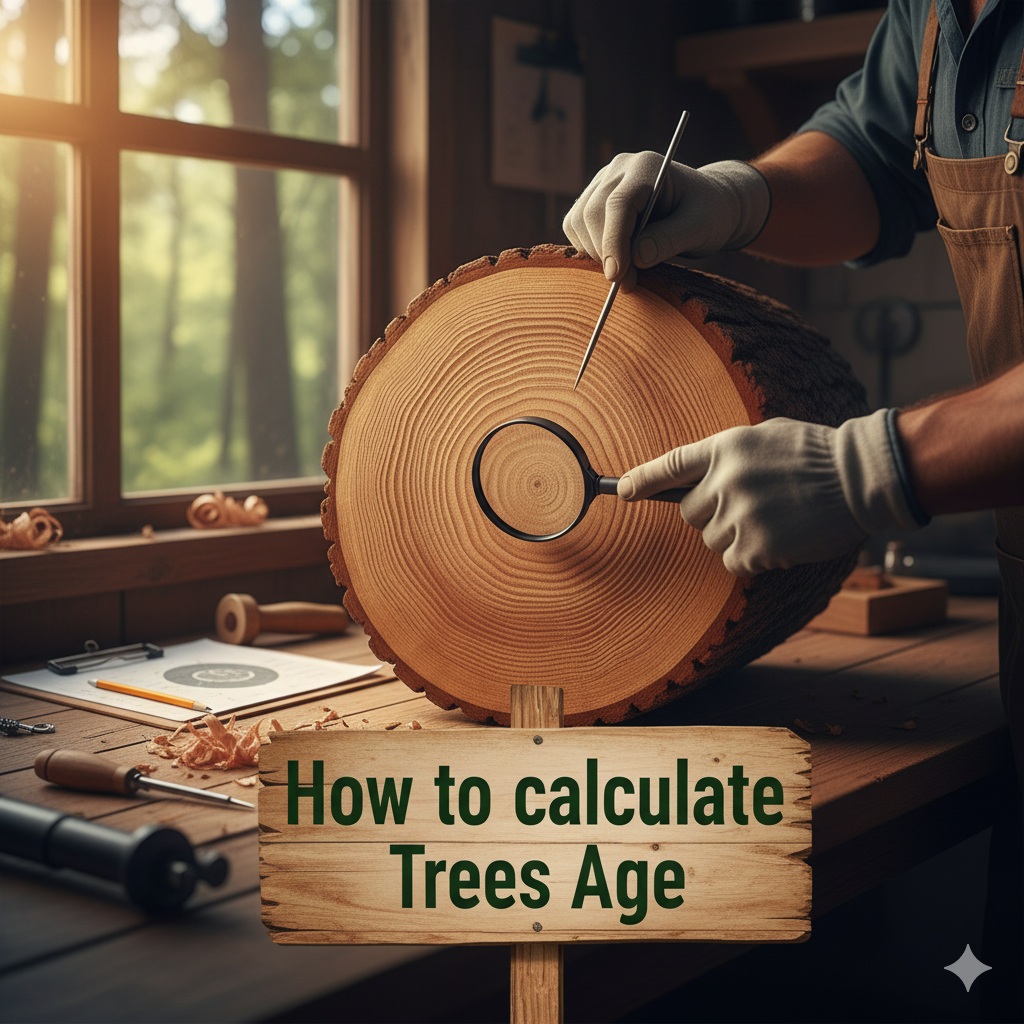
If the tree is cut, fallen, or a core sample is available, counting rings is the gold standard.
🌱 What Growth Rings Are
Each year, a tree produces:
- Light-colored earlywood (spring growth)
- Dark-colored latewood (summer/autumn growth)
Together, one light ring + one dark ring = one year of growth.
🌱 How to Count Rings
- Look at a cross-section (stump, slice, or log).
- Use a magnifying glass if needed.
- Count the pairs of light + dark rings.
- The total count gives the exact age.
🌱 Pros
- Most accurate method
- Works for all tree species
- Reflects real growing conditions
🌱 Cons
- Only possible on cut trees
- Requires sharp eyes or proper tools
- Outer rings may be distorted on old or stressed trees
🌱 Using a Core Sample
Professionals avoid cutting trees by using an increment borer, a device that extracts a pencil-thin core from the trunk.
Advantages:
- Tree remains alive
- Accurate aging
- Useful for studying growth patterns
Disadvantages:
- Requires experience
- May stress the tree if improperly used
🌳 Method 2: Calculate Tree Age by Circumference (Most Popular for Living Trees)
This is the easiest and most common method for standing, healthy trees where cutting or drilling is not an option.
🌲 Step 1: Measure the Circumference
Measure the trunk at 4.5 feet (1.37 m) above the ground, known as DBH height.
Use:
- Measuring tape
- Cloth tape
- Rope + ruler
Write down the circumference in inches.
🌲 Step 2: Use the Growth Factor
Each tree species grows at different rates, so foresters use growth factors — numbers that estimate how fast a trunk expands each year.
🌱 Common Tree Growth Factor Table
| Tree Species | Growth Factor |
|---|---|
| Red Maple | 4.5 |
| Silver Maple | 3.0 |
| Sugar Maple | 5.0 |
| Oak species | 4.0 |
| White Pine | 5.0 |
| Red Pine | 4.5 |
| Spruce | 5.0 |
| Fir | 4.5 |
| River Birch | 3.5 |
| Paper Birch | 3.0 |
| Dogwood | 3.0 |
| Black Walnut | 4.5 |
| Sycamore | 3.5 |
| Cottonwood | 3.0 |
| Cedar | 7.0 |
| Redwood | 3.5 |
| Bradford Pear | 3.0 |
| Elm | 4.0 |
| Hickory | 7.0 |
These factors are averages — environmental conditions influence actual growth.
🌲 Step 3: Apply the Formula
Tree Age = Trunk Circumference ÷ Growth Factor
🟩 Example:
- Species = Oak (growth factor 4.0)
- Circumference = 80 inches
Age = 80 ÷ 4 = 20 years old
This gives a reasonably accurate estimate.
🌳 Method 3: Calculate Tree Age Using Diameter & Growth Factor
Professionals often convert circumference to diameter, then multiply by the growth factor.
🌱 Step 1: Calculate the Diameter (DBH)
DBH = Circumference ÷ 3.14
If circumference = 94 in →
DBH = 94 ÷ 3.14 = 29.9 in
🌱 Step 2: Multiply Diameter × Growth Factor
Example using Sugar Maple (growth factor 5):
Age = 29.9 × 5 = ~150 years
This method is more precise than using circumference alone.
🌳 Method 4: Estimating Tree Age by Species-Specific Growth Rates
Some trees have highly predictable yearly growth under normal conditions. For example:
- Eastern White Pine grows ~1–2 inches in radius yearly.
- Red Oaks average 0.1–0.2 inches DBH per year.
- Fast-growing species like Lombardy Poplar grow much more quickly.
You can use:
- Annual trunk radius increase
- Average height growth
- Branch whorl patterns (conifers, especially pines)
Example: Counting Whorls on Pine Trees
Each year, many pine species produce a ring of branches (a whorl). Count whorls from ground to top to estimate age.
🌳 Method 5: Counting Branch Whorls on Pines (Simple Visual Method)
Certain conifers create one whorl per year.
Steps:
- Locate the first branch ring above the ground.
- Count upward to the top.
- Each whorl = 1 year.
Best For:
- White Pines
- Scots Pines
- Loblolly Pines
Limitation:
- Storm damage, pruning, or herbivory may remove whorls.
🌳 Method 6: Estimate Age By Core Wood (Advanced Botanical Method)
Researchers sometimes analyze:
- Heartwood vs sapwood ratios
- Annual radial expansion
- Environmental growth cycles
This requires:
- Dendrochronology training
- Laboratory measurement tools
This method is used for scientific tree aging in studies of old-growth forests.
🌳 Method 7: Age Estimation by Growth Rate Charts (Quick Visual Method)
Landscapers occasionally use growth charts that track:
- Species height at certain ages
- Average trunk size by decade
- Crown width expansion
This is the least accurate method, but useful when:
- The tree cannot be measured
- Circumference is inaccessible
- Only photos are available
🌳 Factors That Affect Tree Growth Rates
Growth factors vary because tree growth depends heavily on environmental conditions.
🌱 Climate
Warmer climates may accelerate growth.
🌱 Water Availability
Trees near water grow wider and faster.
🌱 Soil Quality
Nutrient-rich soils lead to larger annual rings.
🌱 Competition
Forest trees grow slower than isolated yard trees due to light competition.
🌱 Damage or Disease
Rot, insects, and storms change growth patterns.
🌱 Urban Stress
Trees in cities grow slower due to soil compaction and pollution.
🌳 Which Method Should You Use? (Comparison Table)
| Method | Accuracy | Difficulty | Best For |
|---|---|---|---|
| Ring Counting | ⭐⭐⭐⭐⭐ | Hard | Exact age |
| Increment Borer | ⭐⭐⭐⭐⭐ | Pro | Living trees |
| Circumference ÷ Growth Factor | ⭐⭐⭐⭐ | Easy | Home use |
| Diameter × Growth Factor | ⭐⭐⭐⭐ | Medium | Research & landscaping |
| Branch Whorls | ⭐⭐⭐ | Easy | Young pines |
| Visual Estimates | ⭐⭐ | Easy | Quick assumptions |
🌳 Common Mistakes When Estimating Tree Age
❌ Using the wrong growth factor
Species-specific values vary widely.
❌ Not measuring at the correct height
Always measure at 4.5 feet above ground.
❌ Including root flare in circumference
Bulges near the ground will inflate estimates.
❌ Assuming fast-growing trees are old
Some trees grow 4–6 feet per year in early decades.
❌ Guessing based on height alone
Height is an unreliable indicator due to environmental conditions.
🌳 Frequently Asked Questions
1. Can I determine tree age without measuring anything?
You can guess visually, but accuracy is extremely low.
2. Do all trees produce growth rings?
Yes — but tropical species have faint or irregular rings.
3. Does core sampling harm the tree?
A small wound is created, but it usually heals well if done correctly.
4. Can one branch ring indicate one year?
Only on species with whorl-based growth (mostly pines).
5. Can tree age exceed 1,000 years?
Yes — some bristlecone pines exceed 4,500 years.
🌳 Final Thoughts
Calculating a tree’s age can be as simple as using a tape measure or as complex as performing a dendrochronological study. The best method depends on what you have available:
- If the tree is cut → Count rings (most accurate)
- If the tree is standing → Use circumference ÷ growth factor
- If precision is required for research → Use increment boring
- If it’s a young pine → Count whorls
With the techniques covered in this guide, you can accurately estimate the age of nearly any tree.